


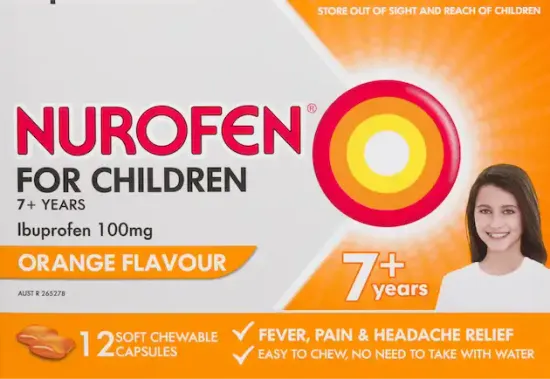
Nurofen for Children 7+ Years Pain & Fever Relief Chewable Capsules
Nurofen For Children Soft Chewable Capsules provides temporary relief of mild to moderate pain such as a sore throat, dental pain, ear ache, headache,
Pain & fever


There are a range of childhood illnesses which most children will potentially experience as they grow up. In particular, newborns and young infants can be more vulnerable to childhood illnesses as their immune systems are still developing. Yet unlike adults, younger children and babies are less able to communicate what they are feeling, which means it may be a little more tricky to know what’s going on with them if they do become sick. As a parent or caregiver, thankfully there are some tell-tale signs you can look out for when it comes to many common childhood illnesses including:
Here we discuss some of the more common childhood illnesses, including their symptoms and when to seek help. It’s important to speak with your doctor if unsure or uncomfortable when your child is not feeling well.
In the first few years of life, there are a variety of childhood illnesses which can occur. Thankfully, most common childhood illnesses are non-serious, and will only make your little one feel unwell or uncomfortable for only a short period of time. However there are also childhood illnesses which are considered serious illnesses or potentially life threatening (including severe allergic reaction). You should seek medical advice immediately if your child has any concerning symptoms like severe pain or difficulty breathing. Your doctor can also provide more information when caring for a sick child.
Here are some examples of common childhood illnesses your child may experience as they grow up:
Conjunctivitis, sometimes referred to as “pink eye,” is an eye infection that can affect babies, young children, also older children, and adults. It can cause an inflammation of the lining that covers the whites of the eyes, as well as the inside of the eyelids (or conjunctiva).
The cause of conjunctivitis can either be infectious (caused by a virus or bacteria) or non-infectious (caused by allergies or something getting caught in the eye area from the environment such as dust or sand). Symptoms of conjunctivitis are usually obvious, as one or both eyes can become pink or red, have yellow-green or sticky discharge, and the eyelashes can also become crusty - especially after sleeping.
If the conjunctivitis is caused by an infection it can be very infectious, spreading to others through direct contact. So maintaining good hygiene such as thorough hand washing is very important. Initially, you can help your baby by using a soft moist cloth to wipe away any discharge; you should then see a doctor for management and treatment options.
As your baby grows, their skin is also still developing, which means skin issues can also occur. One common issue is nappy rash, which is where the skin around the nappy area becomes irritated. Nappy rash is a broad term, and it can occur for several reasons, including irritation from the nappy itself, or infection. Another skin issue is “cradle cap”, which is when the skin produces greasy yellow like scales in areas such as the scalp T-line of the face and ears. Something else your baby can experience is heat rash, which is where small sweat filled blisters appear just underneath the surface layer of the skin. Heat rash usually occurs in warmer months. If your baby is experiencing any skin related issue, speak with your doctor for advice on how to manage.
Nappy rash is common and can be caused by a range of things such as irritation from the nappy, or even infection. Thankfully there are some preventative measures that can be used to help avoid nappy rash including:
There are also medicated products available including creams. To learn more, speak with your doctor or pharmacist to see which product is most suitable for your case. You should also speak with them if the rash looks severe or is not getting better after a few days.
Cradle cap is another common issue, and whilst it may look concerning, it is usually something which clears on its own within a few weeks. Generally speaking, the symptoms of cradle cap are greasy-looking yellowish scales or skin flakes on the scalp, hairline, ears and/or eyebrows. Cradle cap is usually harmless and not typically itchy for your baby. However, it is best to speak with your doctor to make sure it is in fact cradle cap your baby has. Here are some options that may help manage your baby’s cradle cap:
While cradle cap will usually clear on its own, there are some signs and to look out for such as redness or weeping. If these occur, it could be a sign of infection and you should see a doctor. You should also see a doctor if the crust is still present after your baby reaches 3 months of age, or if the crust is not improving, or is spreading to other areas of the body.
To help protect your baby from illnesses caused by infection, there are a number of preventative measures you can take:
During common childhood illnesses such as upper-respiratory tract infections (also known as the common cold), your baby may develop pain or fever. If this happens, there are pharmacological options such as paracetamol or ibuprofen that can be used for the short-term relief of these symptoms.
First published: 7th May 2024
Last updated: 16th July 2024
This article is for general information only and not intended as a substitute for medical advice. All information presented on these web pages is not meant to diagnose or prescribe. In all health-related matters, always consult your healthcare professional.
Always read the label. Use only as directed. Incorrect use could be harmful. Do not use if your child has a stomach ulcer. If symptoms persist see your healthcare professional. Reckitt Benckiser, Auckland RKT-M-33900.